If You Believe You Warrant Benefits, Prepare Like It.
Our TacticalAdvantage™ Frameworks are condition-specific documentation playbooks that show veterans exactly how the VA evaluates evidence — before they submit a claim.
Through an integrated system of assessment, intelligence processing, framework, and secure workspace access, veterans can take control and organize and optimize their claims evidence documentation aligned with publicly available VA rules.
Structured regulatory alignment. No filing services.
Why Documentation Readiness Matters
Many veterans unknowingly file claims without documentation aligned to the VA’s rating criteria.
That often leads to:
• Denials
• Under-ratings
• Years of appeals
A single 30% rating difference can represent tens of thousands of dollars in lifetime benefits.
Preparation isn’t optional.
It’s strategic.
FOUNDER • VETERAN • STRATEGIST
Built by a Veteran Who Went Through the Fight
For nearly 9 years, I navigated the VA claims process without clarity, guidance, or understanding of how decisions were truly made.
I didn’t lose because I lacked evidence. I lost because I didn’t understand the evaluation framework.
So I studied it. I decoded it. I rebuilt the process from the inside out.
VetIntel Solutions™ was created to give veterans what I didn’t have — structured documentation alignment based on publicly available VA rules and rating logic.
Powered by Valorithm™, our proprietary intelligence engine, we translate regulatory standards into practical readiness strategy — before submission.
We do not promise outcomes. We build documentation readiness.
Drew Horne-Cooper
Founder and CEO, VetIntel Solutions™
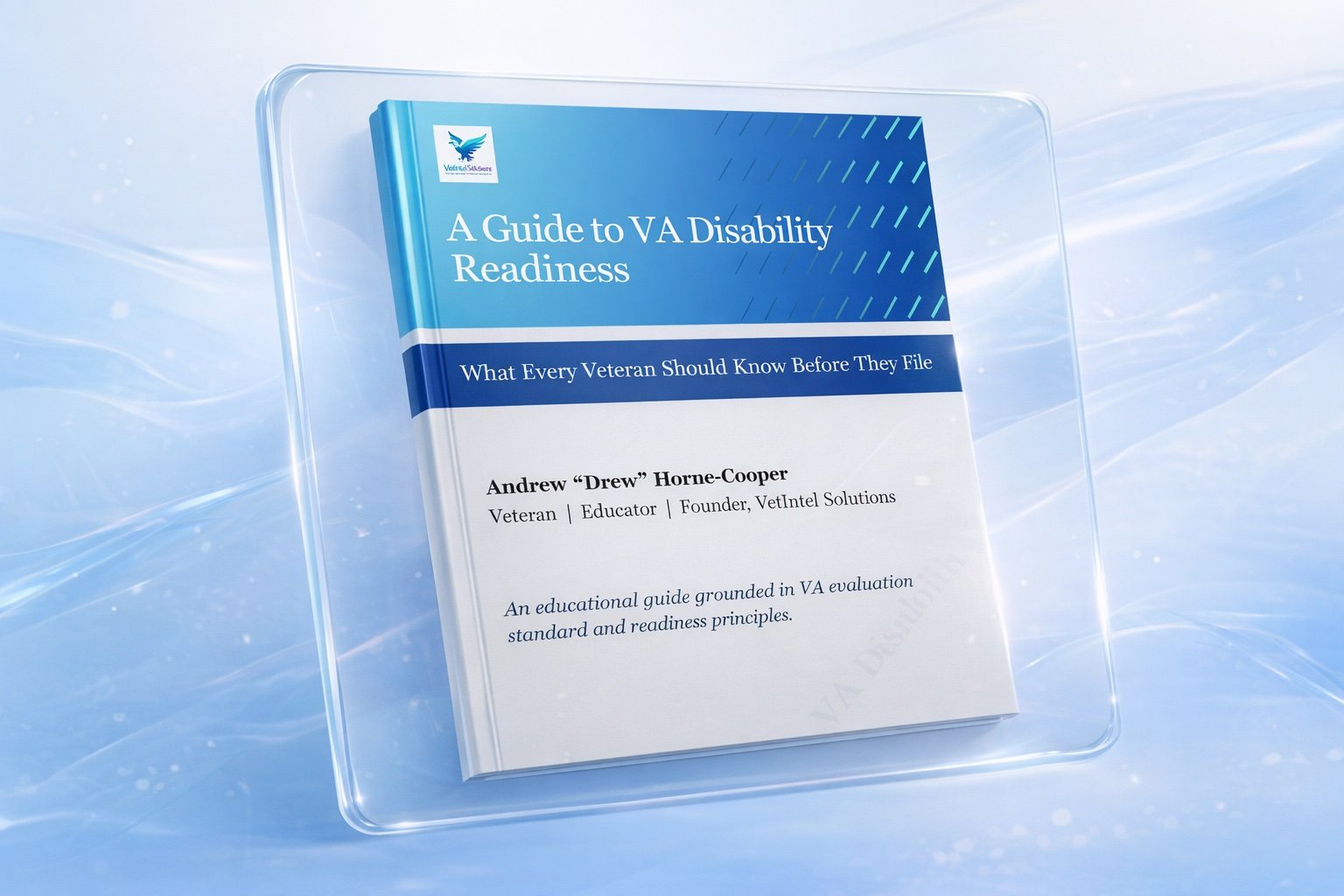
Start Here — FREE "A Guide to VA Disability Readiness"
Understand how the VA evaluates disability claims before you file.
The Veteran Readiness Model™
Why Most VA Claims Struggle Before They Even Begin
Over the past two decades an entire ecosystem has grown around the VA disability claims process.
Veterans today can find help with:
• Representation through
Veteran Service Organizations
and attorneys
• Awareness through social
media, veteran communities, and
educational platforms
Both are valuable.
But there is still a critical layer missing.
That missing layer is PREPARATION.
Without understanding how the VA evaluates evidence, many veterans begin the claims process without the documentation structure the VA needs to see.
This is where many first-time claims run into trouble.
The Four Layers of the Veteran Readiness Model™
Mindset
Get Smart Before You Start
The first step is deciding to approach the VA claims process strategically rather than reactively.
Veterans should never have to learn the system through denial letters.
Awareness
Understand What Benefits May Exist
Today, more veterans are discovering that conditions such as tinnitus, migraines, sleep apnea, PTSD, and musculoskeletal injuries may be service connected.
Awareness has improved significantly in recent years.
But awareness alone does not ensure success.
Preparation
Understand How the VA Evaluates Evidence
This is the missing layer.
Veterans are rarely taught:
• how the VA
evaluates medical evidence
• what documentation may still be missing
• how their conditions align with rating criteria
• what secondary conditions may exist
Without this preparation, many veterans enter the system without understanding how claims are evaluated.
Representation
Filing, Advocacy, and Appeals
Representation has long been available through VSOs and accredited professionals.
But representation is most effective after readiness, not before.
This is where VetIntel Solutions enters the picture.
VetIntel was built to support the Preparation Layer through the ReadinessTech ecosystem.
Our mission is simple:
Help veterans get smart on the process before they start.
Each TacticalAdvantage™ engagement includes a private, secure 60-day documentation workspace.
1.
Establish Your Readiness Baseline
Before strategy comes clarity.
Your ReadinessScan™ evaluates your documentation against VA rating standards and generates your personalized BattlePlan Readiness Summary Report with a Readiness Index™ Score and Band.
You cannot improve what you have not measured.
2.
Translate Insight Into Strategy
Your personalized BattlePlan Readiness™ Summary Report identifies alignment gaps, documentation weaknesses, and next-step priorities based on structured regulatory analysis.
This is where uncertainty becomes positioning.
3.
Execute With Structured Alignment
Through TacticalAdvantage™ education frameworks and ReadinessPass™ workspace tools, you prepare documentation the way the VA evaluates it — with precision, structure, and measurable readiness.
Clarity replaces guesswork.
What Happens When You Use a TacticalAdvantage™ Framework?
When you purchase a TacticalAdvantage™ condition-specific documentation framework, you receive a structured roadmap built around the actual VA rating criteria for that specific condition.
Inside each Framework, you will find:
• The exact Diagnostic Code and evaluation thresholds
• A plain-language breakdown of what drives each percentage level
• Structured documentation guidance aligned to rating criteria
• Common examiner pitfalls that reduce ratings
• Secondary condition identification guidance (when applicable)
• Documentation density modeling — what is often missing
• A private 60-day secure documentation workspace to organize your file
This is where preparation replaces guesswork.
You do not submit blindly. You prepare with structure.
Coming TacticalAdvantage™ Systems
The following condition-specific documentation systems are in active development based on high-volume VA claim categories, common under-rating patterns, and areas where documentation gaps frequently impact outcomes.
Each system is built to align condition evidence with the applicable VA Diagnostic Code criteria and evaluation standards.
MUSCULOSKELETAL CONDITIONS
Lumbar Spine (Thoracolumbar Spine) Documentation System
Aligned to VA General Rating Formula for Diseases and Injuries of the Spine (38 CFR §4.71a).
Focus: Range of motion measurements, flare-ups, functional loss, repetitive use testing, and associated neurological findings.
Cervical Spine Documentation System
Aligned to the same rating formula with condition-specific documentation guidance for neck limitation and functional impairment.
Knee Conditions Documentation System
Includes limitation of flexion (DC 5260), limitation of extension (DC 5261), instability (DC 5257), and related diagnostic considerations.
Focus: Objective measurements, instability findings, and functional impact documentation.
Shoulder Conditions Documentation System
Aligned to DC 5201 and related codes.
Focus: Range of motion thresholds, dominant vs. non-dominant arm considerations, and functional limitation evidence.
NEUROLOGICAL CONDITIONS
Radiculopathy (Lower Extremity) Documentation System
Aligned to sciatic nerve ratings under DC 8520 series.
Focus: Severity classification (mild, moderate, moderately severe, severe), sensory findings, and motor impairment documentation.
Hearing Loss Documentation System
Aligned to DC 6100.
Focus: Audiometric testing interpretation, speech discrimination scoring, and common documentation misunderstandings
GASTROINTESTINAL CONDITIONS
Gastroesophageal Reflux Disease (GERD) Documentation System
Commonly rated by analogy under DC 7346 (Hiatal Hernia).
Focus: Symptom frequency, severity, substernal pain, dysphagia, regurgitation, and overall health impact.
Irritable Bowel Syndrome (IBS) Documentation System
Aligned to DC 7319.
Focus: Frequency of episodes, abdominal distress, and symptom classification (mild, moderate, severe).
CARDIOVASCULAL CONDITIONS
Hypertension Documentation System
Aligned to DC 7101.
Focus: Blood pressure readings, medication management, and historical patterns required for compensable evaluation.
CHRONIC MULTI-SYMPTOM CONDITIONS
Fibromyalgia Documentation System
Aligned to DC 5025.
Focus: Widespread pain documentation, tender points, refractory symptoms, and treatment history.
RATING REVIEW & CORRECTION SYSTEMS
Rating Increase Documentation Framework
Structured guidance for documenting worsening conditions aligned to the existing Diagnostic Code criteria.
Supplemental Claim Documentation Framework
Focus: Structuring new and relevant evidence consistent with VA evidentiary standards.
Higher-Level Review Documentation Framework
Focused on identifying decision review issues based on regulatory application and evaluation criteria.
Combined Rating Review Framework
Educational breakdown of VA math and multi-condition interaction considerations.
These condition documentation systems are designed for veterans who want structured preparation aligned with how the VA evaluates evidence — before submitting or reopening a claim.
Launch announcements will be made as each system becomes available.
Filing without documentation alignment increases the risk of preventable under-rating or denial.
TacticalAdvantage™ Condition Frameworks (Currently Available)
Each framework breaks down how the VA evaluates a specific condition and shows you how to align your documentation before filing.
Build structured documentation aligned to mental health rating criteria — not just symptom narratives.
Why VetIntel Solutions Exists
Most Veterans Submit Blind
The VA evaluates against regulation — not personal belief.
Most veterans never see their file the way the VA does until it’s too late.
Think Like the VA
Understand how your documentation aligns to regulatory strategy — before submission, not after denial.
Prepare Before You File
Prepare documentation the way the VA evaluates it.
IMPORTANT DISCLAIMERS:
VetIntel Solutions -
• is not affiliated with the VA
• does not provide legal advice
• does not guarantee disability outcomes
Built on Public VA Standards
Regulatory Alignment & Transparency
At VetIntel Solutions™, every assessment, framework, and tool is built using publicly available VA regulations and rating criteria — not opinion, speculation, or internal influence.
We do not interpret policy loosely.
Our frameworks are built to reflect how the VA evaluates evidence.
Education-first. No filing services. No representation.
Built using publicly available 38 CFR rating criteria
Structured against documented VA evaluation standards
Education-first model — no claims submission services
No contingency fees, no representation, no filing
Transparent methodology grounded in regulatory analysis
Documentation should be aligned to regulatory standards — not hope.
See How Alignment Works
Example: Migraine
(Diagnostic Code 8100)
The VA states a 50% rating requires:
“Very frequent completely prostrating and prolonged attacks productive of severe economic inadaptability.”
Inside the Migraine TacticalAdvantage™ Framework, you are shown:
• What “prostrating” means in
evaluation context
• How frequency must be
documented
• What qualifies as economic
inadaptability
• Why many veterans are
under-rated at 30%
• How to structure
documentation before
submission
This is documentation alignment — not opinion.
Example: Lumbar Spine
(Diagnostic Code 5237)
The VA rating criteria are based on measurable limitation of motion in degrees.
Inside the Musculoskeletal Tactical Framework, you are shown:
• How range of motion is
measured
• Why repetitive-use testing
matters
• How flare-ups should be
documented
• Where veterans lose
percentage due to incomplete
exam language
Alignment reduces preventable gaps.